Posts

Showing posts with the label osmium

Radiogenic Osmium in Ganga river sediments of India.

Image
Ganga river Sediments are the major source of radiogenic Osmium. by Dr. Nitish Priyadarshi The Ganga sediments are characterized by high Re/Os (rhenium-osmium) ratios and are extremely radiogenic as evident from their 187 Os/ 188 Os isotopic ratios. Samples from the tributaries Alaknanda, Bhagirathi, Gandak and Ghaghra show pronounced 187 Os/ 188 Os. High Os concentrations combined with sediments flux makes the Ganga an important source for soluble Os isotopic evolution in oceans. Interest in rhenium-osmium systematics in rivers has risen sharply in recent years due to the revelation of changes associated with sea water Os isotopic compositions during the past 70 Ma. Radiogenic 187 Os is produced from the β- decay of 187 Re. Osmium isotopic composition in sea water is derived from the weathering of basaltic and peridotitic oceanic crust, hydrothermal solutions, additions from cosmic dust and continental weathering products. Os isotopes in the oceans convey the then prevalent continenta...
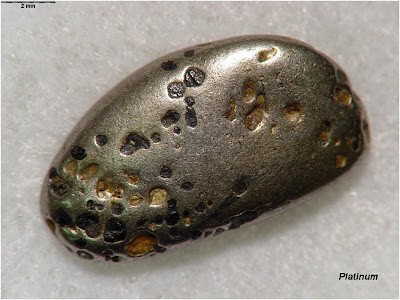
Platinum metal can glitter Jharkhand State of India.

Image
Presence of platinum cannot be ruled out in Jharkhand State of India. by Dr. Nitish Priyadarshi Platinum may be considered one of the precious metals since it is more costly than gold. About 60 percent of that consumed in the United States is for jewelry purposes. It was once used for coinage in Russia until its value exceeded that of the coins. Its name is derived from the Spanish term platina del Pinto, which is literally translated into "little silver of the Pinto River. The metal has an excellent resistance to corrosion and high temperatures and has stable electrical properties. Platinum is only one of a group of related metals consisting of osmium, iridium, palladium, rhodium, and ruthenium. They are not only associated together but also are generally alloyed, and are called, therefore the “platinum metals.” They are very heavy, insoluble in most acids, melt at temperatures of 1,549 degree to 2,700 degree C, and range in hardness from 4.8 to over 7. Iridium is the heaviest m...